
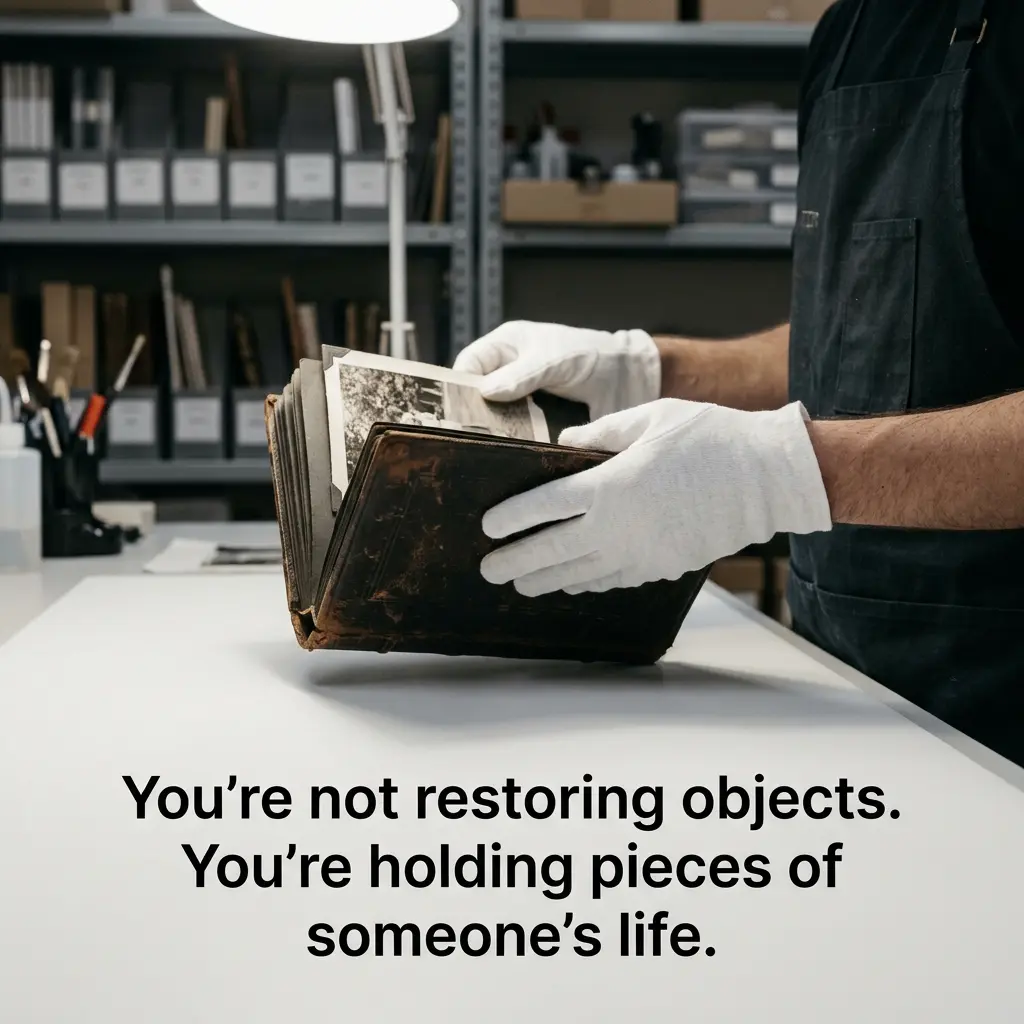

I’ve been in this business long enough to recognize the moment when someone stops seeing objects and starts seeing loss.
It happens when a family walks into a restoration facility after a fire. They’re not looking at furniture. They’re looking at the piano bench where their daughter practiced every afternoon. The wedding dress their grandmother wore in 1952. The photo albums that hold the only images of people who are gone.
You can tell who understands this and who doesn’t within the first sixty seconds of a conversation.
The Industry Treats Items Like Inventory
Most restoration companies operate from a transactional framework. Item comes in damaged. Item gets cleaned, repaired, or replaced. Item goes back to customer. Transaction complete.
The language gives it away. “Contents restoration.” “Salvage operations.” “Loss mitigation.”
These terms describe logistics. They don’t describe what’s actually happening when someone hands you the last tangible connection they have to a person they loved.
According to research on disaster recovery, objects function as cues for memory, habits, culture, and social interaction. Mary-Frances O’Connor, a psychology professor at the University of Arizona, points out that grief is the natural response to loss—and that includes the loss of objects that carry irreplaceable meaning.
When you understand that, the work changes.
Stewardship Means You’re Holding Something That Isn’t Yours
I don’t own the items that come through my facility.
I’m not even really restoring them in the traditional sense. I’m a temporary guardian of something that belongs to someone else—something they’ve entrusted to my care because they can’t bear to lose it and they don’t have the expertise to save it themselves.
Stewardship is the recognition that you’ve been given responsibility for something valuable that you must return in better condition than you received it.
That’s not marketing language. That’s the operational framework.
When a client brings me a family heirloom, I’m not looking at a billable item. I’m looking at a tangible link to their past—an object that embodies history, culture, and personal stories that can’t be replicated or bought.
The psychology research calls this the “essence” phenomenon. People believe objects absorb the spiritual presence of their owners through physical contact and use. These items are imbued with the presence of those who owned them.
You can’t restore that with a cleaning solution and a repair kit.
What Happens When You Operate From Stewardship
The work itself doesn’t change that much on the surface. You still assess damage. You still develop a treatment plan. You still execute restoration protocols.
But the relationship changes completely.
When you operate as a steward, you’re not managing client expectations. You’re managing trust during one of the most vulnerable moments in their lives.
The emotional toll of disaster can be more devastating than the financial strain. Profound sadness, grief, and anger are normal reactions to abnormal events. People aren’t hiring you to fix things. They’re hiring you to provide psychological stabilization through competent care of what they can’t afford to lose.
That changes how you communicate. How you set timelines. How you handle setbacks.
I’ve watched restoration professionals tell clients, “We’ll do our best, but we can’t guarantee results.” That’s accurate from a liability standpoint. It’s also a trust destroyer when someone is standing in front of you holding their grandmother’s wedding dress.
Stewardship means you take responsibility for outcomes without hedging. You don’t overpromise. You don’t lie about timelines. But you also don’t use weasel words to protect yourself from accountability.
You tell them what you can do, what the realistic timeline is, and what the process involves. Then you do it.
The Data Supports the Philosophy
This isn’t just emotional positioning. The numbers back it up.
According to the Institute of Inspection, Cleaning and Restoration Certification, nearly 80% of salvageable content items can be restored with proper treatment. That’s a significant reduction in overall loss.
But here’s what matters more than the percentage: families remember how you treated their belongings during the hardest moments of their lives.
I’ve had clients tell me about items that seemed mundane to everyone else but carried stories no one would understand. One family held onto their grandmother’s TV remote—the one she used to watch Jeopardy every night. Another kept a child’s first piano, even though it was damaged beyond playability, because it represented years of practice and recitals and family gatherings.
Stewardship means you see meaning where others see mundane objects.
That’s pattern recognition. That’s depth. That’s what separates professionals who execute tasks from professionals who understand what they’ve been entrusted with.
How This Applies Beyond Restoration
The stewardship framework works in any business where people are trusting you with something they value.
When businesses operate as stewards, they create environments of trust. Employees feel confident their jobs are secure. Customers believe their needs matter. Suppliers know they’re working with someone who honors commitments.
Good stewardship means taking a long-term view and making decisions that benefit everyone involved—not just shareholders, but employees, customers, suppliers, and the community.
Steward leaders safeguard the future. They exercise judgment and discipline to sacrifice short-term profits for long-term gain. They recognize that wealth of any kind comes with an obligation to hand those assets down in better shape than they inherited them.
That’s not idealism. That’s how you build something that lasts.
The Practical Application
If you’re running a business where people trust you with things they care about, here’s what stewardship looks like in practice:
- You listen more than you talk. Understanding precedes strategy. You can’t be a good steward of something you don’t understand.
- You take responsibility for outcomes. No hedging. No blame-shifting. No excuses. If you accept the responsibility, you own the result.
- You communicate with clarity. People don’t need false hope or corporate jargon. They need to know what’s happening, what’s realistic, and what you’re doing about it.
- You protect what’s been entrusted to you. That means treating their belongings, their information, their trust with the same care you’d want if the roles were reversed.
- You return things in better condition than you received them. That’s the standard. Not “good enough.” Not “we tried our best.” Better than when it arrived.
Why This Matters Now
I’ve watched the restoration industry shift toward efficiency metrics and cost optimization. Companies are outsourcing work, automating processes, and treating restoration like a manufacturing operation.
That works fine until someone’s life is in boxes.
The families who walk into a restoration facility after a disaster aren’t looking for the cheapest option or the fastest turnaround. They’re looking for someone who understands what they’re holding.
Stewardship creates loyalty that contracts can’t replicate. It generates referrals that marketing can’t buy. It builds businesses that survive market shifts because they’re anchored to something deeper than transactions.
I’ve been doing this for 64 years. I’ve seen every iteration of industry trends, every new efficiency model, every attempt to optimize the human element out of the process.
The businesses that last are the ones that recognize they’re not in the restoration business. They’re in the stewardship business.
Everything else is just logistics.
What You Can Do With This
If you’re running a business where trust matters, start by asking yourself one question: Are you managing transactions or stewarding what’s been entrusted to you?
The answer shows up in how you communicate, how you handle problems, and how people describe working with you after the project is done.
Stewardship isn’t a marketing position. It’s an operational framework that changes how you see your role, your responsibility, and the value you bring when people need you most.
You don’t need a mission statement to implement it. You just need to recognize that when someone trusts you with something they can’t afford to lose, you’re holding more than an object.
You’re holding a piece of their life.
We treat it that way.